

“How to empower students to become good Math Problem solvers and enjoy the process of solving Math problems.” – is discussed in this 6-part blog series.
The first part discusses about various challenges faced by young students (primary & middle school) while working on Math problems and the needs of a student to become a good problem solver.
“I like Mathematics and play with numbers. But I am afraid of Algebra and its very challenging for me” told a Class 9 student who is very good in science.
“I always lose marks in word problems and my teacher says I cannot understand them correctly” told a Class 5 student who is very good in mental arithmetic.
“I can solve Math problems with keywords; when the problems are tricky I get confused on where to start!” told a Class 7 student who likes Mathematics.
Often we as parents or teachers hear these statements from our students and might respond saying
“Practice more and you will be able to solve them”
Isn’t it like the famous woodcutter story who got tired of kept cutting the tree without knowing that the axe needed sharpening?
The need of the hour is to understand the reasons in general, students face as challenges while solving Math problems and guide them accordingly. Rather than suggesting a solution “Practice more” that works at the surface level.
Many education researchers have attributed the reasons given below for the challenges faced by students while solving Math problems.
- Lack of comprehension
- Do not know to mathematize the given problem
- How to start working on the problem or finding an approach to work
- Do not know to identify & connect which Math concept to be applied to solve a problem
Besides these reasons, there are others like phobia on seeing bigger numbers or very small decimal numbers or operations involving brackets or “-ve” sign etc. While these are more specific to specific Math concepts & skills the reasons stated above are the general ones which inhibit students from solving Math problems.
The figure shown highlights the dimensions of Mathematical knowledge base. While this blog series talks about the “Processes” dimension to facilitate problem solving, it is also important to note “Dispositions” that involves Habits of mind, attitudes and values are equally important and play a key factor to arouse interest among students on Mathematical thinking, working and solving.
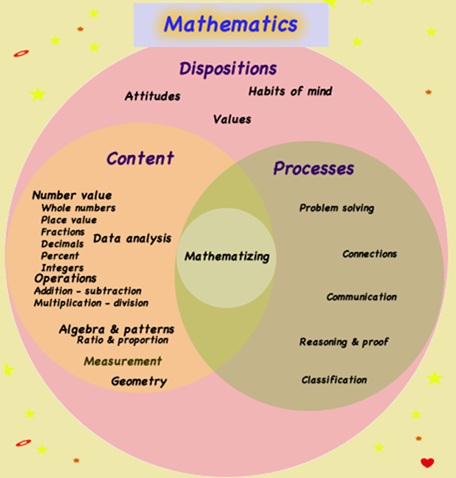
Credits: homeofbob.com – notes to educator on facilitating Mathematical literacy
When students share their musings about solving problems and challenges faced, they are indeed stating their inabilities implicitly:
“How to start working on a problem?”
“How to understand a problem?”
“How to identify & connect the math concept needed to solve this problem?”
“How to avoid the mistakes made”
George Pólya, a famous Hungarian Mathematician shared a four-step framework that supports students to build capabilities to solve problems. The four-step approach is slightly paraphrased and provided here with an acronym “UPER” which expands to
- Understand
- Plan
- Execute
- Reflect
I personally think that empowering students with the process of problem solving serves two-fold purpose; cultivating problem solving skills and at the same time interest towards problem solving: pushing themselves from being a novice learner to a challenger with growth mindset.
Concluding the first part of this series with words from Pólya
“… a teacher of mathematics has a great opportunity. If he fills his allotted time with drilling his students in routine operations he kills their interest, hampers their intellectual development, and misuses his opportunity. But if he challenges the curiosity of his students by setting them problems proportionate to their knowledge, and helps them to solve their problems with stimulating questions, he may give them a taste for, and some means of, independent thinking.”
– Pólya, George. How To Solve It. 1945.
In the upcoming part of this blog series, UPER technique will be delved deeper.
